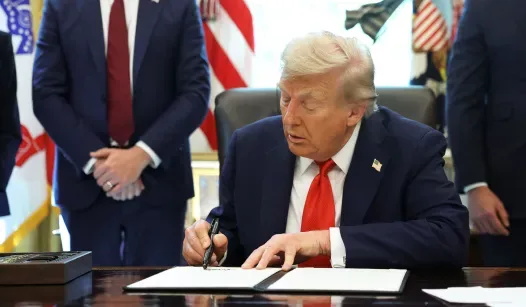
Former President Donald Trump’s executive order regarding flag-burning has sparked considerable debate and confusion, diverging from the typical presidential approach to constitutional matters. Unlike many leaders who often downplay their controversial decisions, Trump’s stance on this issue has been anything but subtle.
The executive order aimed to address the sensitive topic of flag desecration, a subject that has long been a flashpoint in American political discourse. While the Supreme Court has ruled that flag burning is protected under the First Amendment, Trump’s directive sought to challenge this legal precedent, raising questions about the balance between free speech and national symbols.
This order is emblematic of Trump’s broader political strategy, which often involves taking a hardline stance on issues that resonate with his base. By framing flag-burning as an affront to patriotism, he effectively galvanized support among those who view the American flag as a sacred symbol. This approach not only appeals to his core supporters but also serves to polarize the political landscape further.
Critics of the executive order argue that it undermines the very freedoms that the flag represents. They contend that attempts to legislate against flag desecration could lead to a slippery slope of restricting free expression. The First Amendment is a cornerstone of American democracy, and any perceived attack on it invites significant backlash from civil liberties advocates.
Moreover, the timing of Trump’s executive order cannot be overlooked. It came during a period of heightened political tension and social unrest in the United States, where issues of race, identity, and national unity were at the forefront of public consciousness. By focusing on flag-burning, Trump shifted the narrative away from more pressing issues, such as police reform and systemic inequality, to one that emphasizes loyalty and patriotism.
In the broader context of American politics, this executive order reflects a trend where symbols and imagery are often weaponized in political discourse. The flag, as a powerful national symbol, becomes a battleground for competing ideologies. For some, it represents freedom and democracy; for others, it embodies a history of oppression and exclusion.
The implications of Trump’s executive order extend beyond the immediate controversy. It raises important questions about the role of symbols in politics and how they can be manipulated to serve specific agendas. As the nation grapples with its identity and values, the flag remains a potent symbol that can unite or divide.
As we analyze the ramifications of this executive order, it is crucial to consider its impact on future administrations. Will subsequent leaders feel emboldened to challenge constitutional norms in similar ways? Or will there be a collective pushback against such tactics, reinforcing the importance of upholding democratic principles?
In conclusion, Trump’s executive order on flag-burning is not merely a legal maneuver; it is a reflection of the complex interplay between politics, identity, and freedom of expression in America. As the nation continues to navigate these challenging waters, the way we engage with symbols like the flag will undoubtedly shape the future of American political discourse. Understanding this dynamic is essential for anyone seeking to grasp the evolving landscape of U.S. politics.