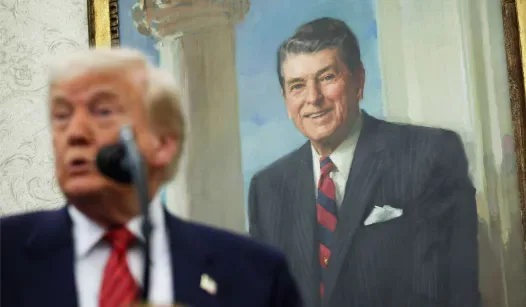
The American political landscape is often shaped by the ideologies and figures that dominate its discourse. One of the most influential figures in this realm is Ronald Reagan, whose policies and principles have left a lasting imprint on the Republican Party and the broader conservative movement. As the political climate continues to evolve, particularly with the rise of Trumpism, many on the right grapple with a pressing question: Is Trumpism merely a phase, or does it signify a deeper transformation within the party?
To understand the current state of American conservatism, it’s essential to examine the roots of Reaganism and its enduring impact. Reagan, who served as the 40th President of the United States from 1981 to 1989, championed a vision of limited government, free markets, and strong national defense. His presidency marked a significant shift in American politics, as he successfully united various factions of the right under a cohesive ideological banner. This coalition included traditional conservatives, libertarians, and evangelical Christians, all of whom found common ground in Reagan’s vision.
Reaganism is characterized by several core tenets that continue to resonate with many conservatives today. First and foremost is the belief in the power of free markets to drive economic growth and prosperity. Reagan famously articulated this philosophy through his supply-side economic policies, which emphasized tax cuts and deregulation as means to stimulate investment and job creation. This approach not only revitalized the American economy during the stagflation of the late 1970s but also set the stage for decades of economic expansion.
Another critical aspect of Reaganism is its emphasis on a strong national defense. Reagan’s administration faced significant challenges, including the Cold War and the threat posed by the Soviet Union. His commitment to military strength and a robust foreign policy helped to reshape America’s role on the global stage, contributing to the eventual collapse of the Soviet regime. This focus on national security remains a cornerstone of conservative ideology, influencing contemporary debates on defense spending and military engagement.
Moreover, Reagan’s ability to communicate a sense of optimism and American exceptionalism played a crucial role in his political success. His charismatic persona and effective messaging helped to inspire a generation of conservatives who viewed the United States as a beacon of freedom and opportunity. This narrative continues to be a powerful tool for conservative politicians, even as the political landscape shifts.
However, the rise of Trumpism has introduced new dynamics within the Republican Party, leading some to question the relevance of Reagan’s principles. Trumpism, characterized by populism, nationalism, and a more confrontational approach to politics, has attracted a different coalition of supporters. Many of these individuals feel disillusioned by traditional conservative elites and are drawn to Trump’s promises to disrupt the status quo.
Critics of Trumpism argue that it diverges significantly from the foundational principles of Reaganism. They point to Trump’s skepticism of free trade, his embrace of protectionist policies, and his often incendiary rhetoric as evidence of a departure from Reagan’s vision. Additionally, Trump’s approach to governance—marked by a disregard for established norms and institutions—raises concerns about the long-term implications for the Republican Party and American democracy.
Yet, despite these tensions, it would be premature to dismiss Reaganism as obsolete. The core values of limited government, individual liberty, and a strong national defense still resonate with a substantial portion of the electorate. Many Republicans continue to invoke Reagan’s legacy in their campaigns, seeking to align themselves with the ideals that once united the party.
Moreover, the ongoing debates within the GOP reflect a broader struggle for the soul of the party. As Trumpism continues to exert influence, a faction of Republicans is actively working to reclaim Reagan’s vision and restore the party’s traditional conservative principles. This internal conflict is indicative of the dynamic nature of American politics, where ideologies evolve and adapt to changing circumstances.
In conclusion, the question of whether Trumpism is a fleeting phase or a fundamental shift in American conservatism remains open to interpretation. While the rise of Trump has undoubtedly transformed the political landscape, the enduring legacy of Reaganism continues to shape the discourse within the Republican Party. As conservatives navigate this complex terrain, the principles established by Reagan will likely remain a reference point for those seeking to define the future of American conservatism. Ultimately, the interplay between these ideologies will play a critical role in shaping the direction of the Republican Party and the broader political landscape in the United States.